
EV Charging Infrastructure: Cable Strategy from Grid Connection to Charger Outlet

Download the
Engineering Spec Pack
EV CHARGING INFRASTRUCTURE: CABLE STRATEGY FROM GRID CONNECTION TO CHARGER OUTLET
An EV charging site benefits from specifying its external cable layers as one programme: grid-side cabling from the transformer or substation feeder to the charger cabinet, and charge-gun cable assemblies between the charger and the vehicle. Charger-internal cabling is determined by the charger OEM and sits outside this scope. AC charging cables can be standard EV charging-rated cable specified to the relevant application standard. DC fast charging and higher-power cables need to be sized for the duty cycle and for the cable-to-connector strain that comes from hundreds of plug-in events per week on a busy site. Connector and compliance requirements vary by market and charger platform, so cable choices that hold up over service life are the ones specified to handle the worst-case combination of current, ambient temperature, handling frequency, and applicable local standards.
The cable between the grid and the charger, between the charger and the gun, between the gun and the vehicle is rarely the focus of EV charging conversations. The charger box and the connector standard get the attention. This guide focuses on the cable strategy: what sits at each layer of the EV charging site architecture, what makes DC fast charging cables fail early, and what changes when you are specifying for a fleet depot or charging hub rather than a single charge point.
Which Cables Sit Between the Grid, the Charger and the Vehicle in a Typical Site Architecture?
An EV charging site has three external cable layers.
Grid-side cabling runs from the transformer or substation feeder to the charger cabinet. This cable carries the full charger load, often at medium or low voltage depending on the site configuration. On a multi-charger depot, this can run to several hundred amps or more at low voltage. Once the cable tray is buried or ducted, upsizing is expensive or not possible. This cable is specified once and lives with the site for 15 to 20 years. Getting it right at the design stage matters more than it does at the charger level.
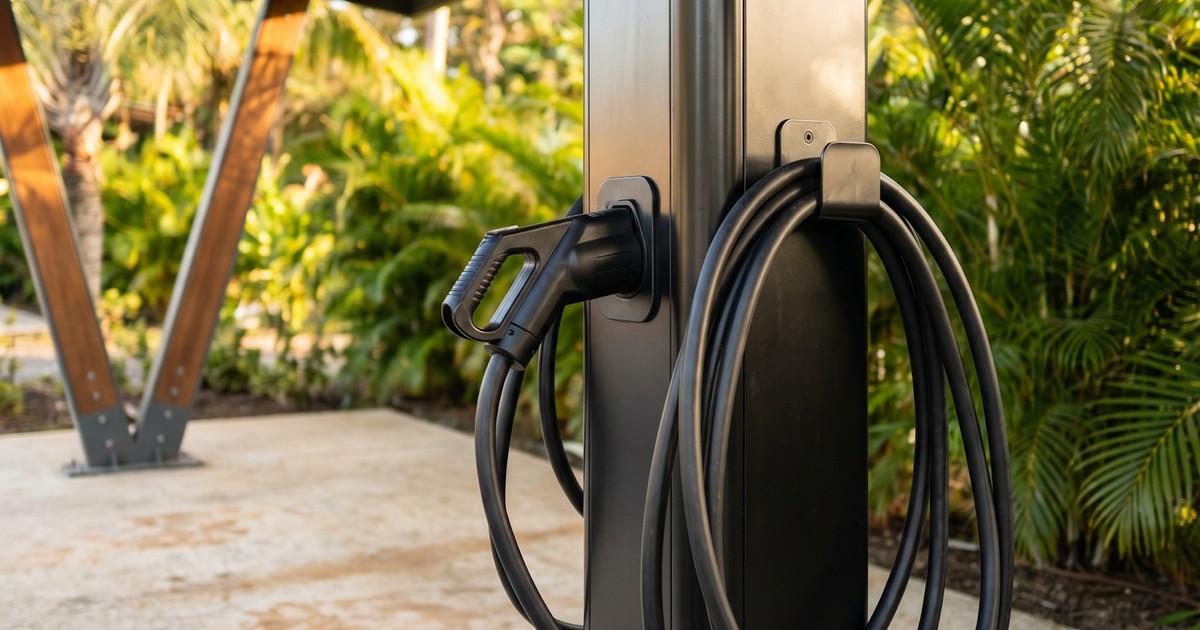
Charger-to-gun cabling connects the charger output terminals to the charge gun and connector at the vehicle. For AC charging (Mode 2 and Mode 3), these are EV charging-rated cables designed to handle regular handling and exposure. For DC fast charging (Mode 4), the current is higher and the cable gets handled more frequently, which drives the selection criteria discussed in the next section.
Charge-gun assembly covers the cable section that runs from the gun handle to the CCS, CHAdeMO, GB/T, or MCS connector at the vehicle socket. This is the highest-stress section of the cable on a fast-charge site. It is picked up and plugged in hundreds of times per week, exposed to UV, heat, rain, and physical impact.
LAPP’s APAC portfolio covers the AC charging cable, DC fast charging cable, and grid-side power cable layers. The e-mobility industry page has the full product picture for the ASEAN region, and the Mode 4 DC charging cable category page shows the high-power options.
How Should DC Fast Charging Cables Be Specified for Duty Cycle and Handling?
The failure mode for DC fast charging cables on high-utilisation sites is not usually insulation breakdown from voltage stress. It is mechanical fatigue at the cable-to-connector joint, jacket cracking from repeated coiling and uncoiling, and strain-relief failure where the cable enters the gun body.
Three specification points drive service life:
Current rating with thermal derating. The charger’s peak current rating is not the only number. The cable runs in ambient temperatures that can reach 40°C or higher in ASEAN outdoor applications. IEC 60364-5-52 provides derating tables for installation methods and ambient temperature. A cable sized for European ambient temperatures at the same nominal current is undersized for an outdoor fast-charge column in Singapore in August.
Jacket material for outdoor UV and handling. EV charging cables that get picked up and dragged across pavement accumulate abrasion damage faster than cables that stay in a fixed installation. Rubber and TPE jackets with specified abrasion ratings handle this better than standard PVC. LAPP’s EV charging cable range specifies jacket materials against outdoor and handling conditions.
Minimum bend radius in the gun body. The gun design determines how tight the cable has to bend at the point where it enters the handle. A cable specified above the minimum bend radius of the gun geometry will fatigue at that point. For field-assembled charge guns, confirm the cable OD and minimum bend radius against the gun body geometry before finalising the cable selection.
The Solar DC Connectors guide from February covers DC connector selection in the solar context, which shares the UV, outdoor, and high-current specification discipline with EV charging.
What Changes When Specifying for a Depot or Charging Hub Versus a Single Charge Point?
A single charge point is a two-cable specification: one grid-side cable and one charger-to-gun cable. A depot or charging hub is a cable management problem.
Cable schedule scope. At a 50-charger depot, the grid-side cable schedule has to account for diversity factor, harmonic load from multiple simultaneous charging sessions, and future capacity headroom if the depot is expected to grow. A single-charger template scaled up by 50 does not produce a correct cable schedule.
Standardisation across bays. A depot where every bay uses the same cable schedule and the same connector type simplifies maintenance and spare parts management. Mixed cable specifications across a depot create troubleshooting friction when a bay goes down.
Future-proofing the grid connection. The grid-side cable is the hardest part of the site to upgrade. If the depot is being built for a 50-vehicle fleet today but the operator expects 150 vehicles in three years, the grid-side cable needs to be sized for the target fleet, not the Day 1 headcount.
LAPP supplies solar PV cabling, BESS cabling, and EV charging cabling as part of a coordinated electromobility offer. For sites where solar feeds the batteries and the batteries buffer the charging peaks, having the cable specification for all three layers on one BOM simplifies vendor coordination. The renewable energy industry page and the LAPP SEA e-mobility page cover both sides.
Talk to Our Engineers
LAPP supplies cables AND connectors for AC and DC EV charging applications, grid-side power cabling, and the coordinated electromobility offer that connects solar, BESS, and EV charging infrastructure. LAPP SEA holds stock across ASEAN with engineering support for specification confirmation.
Our connectivity specialists can confirm the cable selection for your EV charging site from grid connection to charge gun. Talk to our engineers at jj-lapp.com/contact-us/ or visit jj-lapp.com/industries/e-mobility/ for the full e-mobility cable programme.