
AMR/AGV Fleet Scaling: A Reusable Connectivity BoM Guide
Download the
Engineering Spec Pack
AMR/AGV Fleet Scaling: A Reusable Connectivity BoM Guide
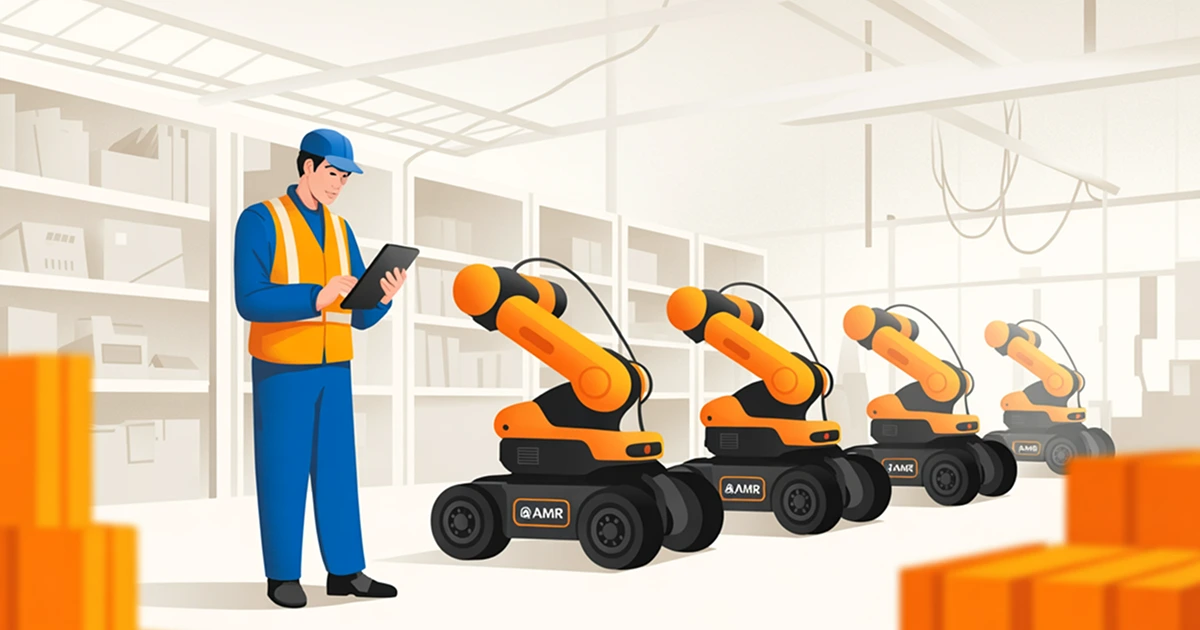
A camera mast on a new Autonomous Mobile Robot (AMR) fails after just one week of operation. The vision link is dead. The problem is not the camera; it is a standard Ethernet cable that has been twisted to failure by the mast’s rotation.
This is not a one-off repair. This is a critical design flaw. That same cable is now inside 60 other identical AMRs on the factory floor, and every single one is a ticking time bomb.
As industry reports from the International Federation of Robotics (IFR) show, AMR/AGV fleets are scaling rapidly. But when scaling from five robots to 500, every “small” connectivity flaw is magnified. Intermittent LiDAR resets and cable fatigue do not just create one breakdown. They create a fleet-wide maintenance nightmare.
Reliability at scale is a designed outcome, built on a standardised connectivity Bill of Materials (BoM). This guide explains how to create a single, reusable BoM that makes a fleet reliable, serviceable, and ready to scale.
Pillar 1: Standardising the Core Cable BoM (Torsion vs. Motion)
The first step is to stop treating all “moving cables” the same. The cable in a drag chain (flex) and the cable in a rotating mast (torsion) face completely different forces.
- Flex (Motion): This is a simple back-and-forth bend, like in a cable chain.
- Torsion (Twist): This is a rotational twist along the cable’s axis, which will destroy a standard cable in days.
A reusable BoM specifies the exact cable family for each application:
- Torsion Zones (Masts, Booms): This application typically requires a torsion-rated data cable like LAPP ETHERLINE® TORSION, which is built to withstand millions of twist cycles.
- Motion Zones (Drives, Gantry): High-flex, chain-rated cables like ÖLFLEX® are the common choice for reliable power and control in moving chains.
- Data Backbones: A robust, shielded Industrial Ethernet cable (e.g., Cat6A) is the standard for all high-bandwidth static runs.
Pillar 2: Standardising Connectors and Labels
Inconsistency is the enemy of fast maintenance. This part of the BoM defines connector and labelling conventions.
- Connector Policy: This involves defining where each type is used.
- M12 X-Coded: Often used for “in the field” connections to sensors, cameras, and LiDAR. They are rugged, IP67-rated, and vibration-proof.
- Industrial RJ45 / EPIC® Connectors: A common choice for inside protected cabinets or for quick-disconnect service panels.
- Label Map: A best practice is ensuring every single cable, port, and device has a logical ID that matches the drawings (e.g., MAST-CAM-01). A non-labelled cable in a complex harness is a 3-hour troubleshooting job, not a 15-minute fix.
Pillar 3: Designing for Service with Modular Harnesses
A key strategy is to avoid building the robot as one giant, tangled harness. The alternative is designing it as a set of serviceable modules.
This approach views the robot in logical blocks:
- Camera Mast Module
- Front Safety/LiDAR Module
- Drive Bay / Motor Module
- Battery / Charging Interface Module
Each module is a self-contained, pre-assembled harness with its own connectors. When a cable in the mast fails, the technician doesn’t grab a soldering iron. They unbolt the module, swap in a pre-kitted spare harness, and get the robot back online in 15 minutes.
Pillar 4: Integrating EMC & IP Protection
“Mystery” LiDAR resets or sensor dropouts are almost always EMC (noise) problems. The robot’s own drive motors are the biggest source of noise, corrupting the data signals from its sensors.
The BoM is the perfect place to integrate two physical habits:
- 360° Shielding: This principle ensures every shielded cable entering the main control cabinet is terminated with a SKINTOP® EMC cable gland. This avoids “pigtails,” which can act as antennas for noise.
- IP Rating: This involves using the correct IP-rated glands and connectors for each zone. A robot driving through a humid loading dock needs IP68/IP69 protection to prevent moisture from destroying its connections.
Pillar 5: Standardising the Spare & Toolkit
The reusable BoM extends beyond production and into service. Based on the BoM, a standard “Fleet Service Kit” can be created for each site.
This kit should contain:
- One spare harness for each “module” (Mast, Safety, Drive).
- A set of pre-cut, pre-terminated patch leads.
- A small stock of the exact glands and connectors from the BoM.
- A label maker with the correct template.
This approach turns every technician into the best technician. They have the right part, the first time, every time.
The Bottom Line: “Copy-Paste” Your Reliability
Reliability at fleet scale comes from standardisation. By “freezing” the connectivity BoM, the core DNA for a reliable robot is defined. This shifts the focus from fighting individual, random faults to building a fleet where every unit is a perfect, serviceable, and robust copy of the last.
This modular, kitted approach is the foundation of modern intralogistics manufacturing, allowing OEMs and service teams across ASEAN to work from the same, reliable standard.
Frequently Asked Questions (FAQ)
Isn’t a torsion-rated cable too expensive? A torsion-rated cable costs more than a standard one, but a single service call—including downtime, labour, and parts—can cost 10 to 20 times more. This presents a choice: paying once for the correct cable or paying for a lifetime of intermittent failures.
M12 or RJ45? What’s the right choice? M12 connectors are ideal for any connection exposed to motion, vibration, dust, or moisture (e.g., on a sensor, camera, or mast). Industrial-grade RJ45 connectors are best used only inside protected, static control cabinets where density is needed.My contract manufacturer (CM) builds my harnesses. Why should I create this BoM? The owner of the BoM ultimately owns the downtime. A CM will often build to the lowest possible cost unless a strict, frozen BoM is provided. Specifying the exact part families, connector types, and harnessing modules ensures they are building a serviceable, reliable robot, not just a cheap one.